
Cashflow modelling turns “it depends” into a picture you can actually look at — a year-by-year view of your income, savings, investments and pensions, projected across the whole of your life, so you can plan around it with confidence.
Cashflow modelling turns “it depends” into a picture you can actually look at — a year-by-year view of your income, savings, investments and pensions, projected across the whole of your life, so you can plan around it with confidence.
Will I have enough, and will it last? When can I afford to stop working? Can I help the children onto the property ladder and still be secure myself? What happens to my money if I need care later, or if I die? Most people who think about cashflow modelling arrive with a version of these questions. The honest answer always seems to be “it depends” — and cashflow modelling is the tool that turns that into a picture you can look at, and plan around.
At H&D Financial Planning, we are independent financial advisers based in Maidstone, Kent, helping clients across Kent, London and the South East, and remotely nationwide, see what their financial future could look like, and plan around it with confidence.
~85
Average life expectancy for a man aged 65 (FCA, citing ONS)
1 in 4
Chance that man reaches age 92
3.1%
Chance of reaching age 100 (higher for women)
Cashflow modelling is a year-by-year forecast of your finances across the whole of your life. It brings together your income, spending, savings, investments and pensions, and projects them forward to show how your money is likely to behave over time: when it grows, when you start drawing on it, and whether it lasts as long as you do.
It is built with a financial planner using specialist software, based on your real numbers and a set of clearly stated assumptions about things like investment growth, inflation and how long you might live.
What makes it useful is not the chart itself but what the chart lets you do. Change one thing — retire two years earlier, give a lump sum to a grandchild — and you can watch how the rest of your life responds.
What it is
What it is not
Whichever spelling you have seen — cashflow modelling, cash flow modelling, cash flow planning — the idea is the same: a map of your financial life that lets you test decisions before you make them. The real work of lifetime cashflow planning is not predicting the future, but understanding the shape of it well enough to make good decisions now.
The point of a forecast is to answer the questions that matter most. A well-built model speaks directly to them.
The forecast shows, on your numbers, the earliest point you could stop working without running short later — and what changes if you wait, or go part-time first.
It projects your savings, investments and pensions against your expected spending across a full retirement, so you can see whether the money is likely to outlast you or run thin.
Gifting to children or grandchildren, helping with a deposit or school fees: the model shows whether a gift leaves you secure or stretches you, before you commit.
You can test the effect of later-life care costs, and see what is likely to be left as a legacy — including whether your estate might face an inheritance tax bill.
Because the forecast accounts for the different tax treatment of pensions, ISAs and other savings, it helps show the order of drawing on them that keeps more of your money working.
The retirement date, the holidays, the help you give your family, the security you keep for yourself. This is where cashflow modelling becomes lifestyle financial planning, not the other way around.
Example cashflow forecast
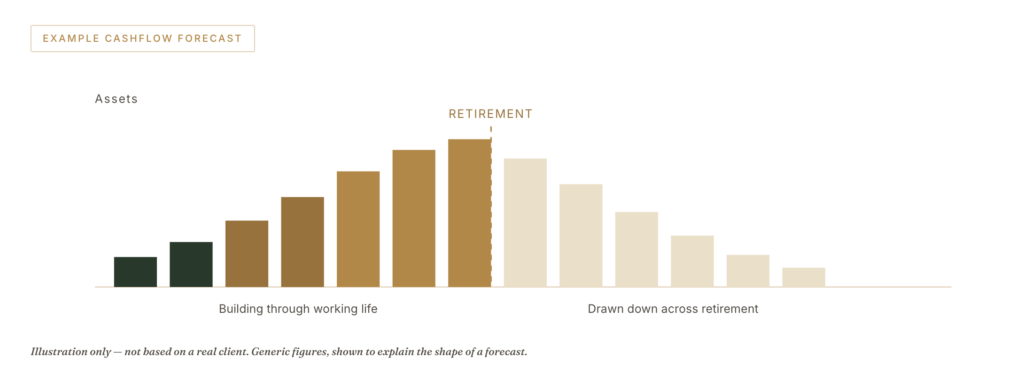
Illustration only — not based on a real client. Generic figures, shown to explain the shape of a forecast.
Here is the part most cashflow modelling pages leave out. A forecast is only as good as the assumptions behind it, and it is surprisingly easy to build one that looks reassuring and means very little. A model that assumes smooth, optimistic growth, ignores inflation, and stops at average life expectancy will almost always tell you what you want to hear. The work is in building one that tells you the truth.
The growth rates a forecast uses should be reasonable and defensible, not last year's strong returns projected forward in a straight line. Past performance is not a guide to the future, and a model that pretends otherwise is not much use.
A good forecast can be shown in "real" terms — adjusted for inflation, in today's money — so that "£40,000 a year in 2045" means something you can picture, rather than a number inflation has quietly hollowed out.
Average is a trap. Roughly half of people live longer than average, so a plan that runs out at the average age leaves a real chance of outliving the money. A forecast worth trusting plans for a long life, not an average one.
It is one thing to see what happens if everything goes to plan, another to see what happens if markets fall sharply the year you retire. A useful model is tested against a poor run, not just a good one.
Tax and the cost of investing both take a real bite out of returns over decades. A forecast that ignores them overstates what you will have.
Rather than drawing a single confident line into the future and calling it certainty, a good model shows alternative scenarios side by side, so you can see the range of outcomes and where the genuine choices lie.
This rigour mirrors the FCA’s good-practice expectations for cashflow modelling, which set out why justifiable, stress-tested, real-terms forecasting matters when planning for retirement.
You do not need to arrive with everything in order; part of the value of the process is that we help you pull the picture together. The information that goes into a model usually covers your income, your regular outgoings and larger one-off costs, your savings and investments, and your pensions. It also helps to know about the changes you can see ahead — an inheritance, children heading to university, a plan to downsize, a business sale, or a date you are hoping to retire by. None of this needs to be precise to the penny: a reasonable estimate is enough to start, and the forecast sharpens as the detail firms up.
What you should expect in return is not a single answer carved in stone, but a clear, honest picture you can interrogate — and a plan you can come back to and adjust as life moves on.
Cashflow modelling sits at the "Analyse" stage of our wider financial planning process.
It shows what your estate might look like and what you can afford to give away while staying secure.
The long-term picture helps shape how money is invested and drawn over time.
When can I afford to retire, and will the money last? Exactly the question a forecast is built to answer.
If you are weighing up how much you need to retire, a cashflow forecast is how that question gets a personal answer rather than a rule of thumb.
Our cashflow modelling service follows the same three-step process we use across our financial planning. The structure is simple on purpose; the value is in how carefully each step is done.
Gather your numbers and your goals; build the base forecast.
We gather the facts — your income, spending, savings, investments and pensions — and talk about what you want: when to retire, the lifestyle you are planning for, the people you want to look after, and the changes you can already see coming, such as an inheritance, downsizing, or university costs. From that we build your base forecast: the picture of your financial life as it stands today, carried forward.
Agree the plan the forecast points to, and put it into action.
A forecast is only useful if it leads somewhere. Once you can see the picture and the scenarios that matter to you, we agree the plan it points to and put it into action — connecting it to the rest of your finances, including pensions, investments, tax and protection, so the decisions hold together rather than being made in isolation.
Revisit the model as life and markets change.
A cashflow plan is not built once and filed away. Markets move, tax rules change, and life rarely follows the straight line a forecast assumes. We revisit the model at agreed intervals, and whenever something material happens — a redundancy, an inheritance, a change in health or plans — so the picture stays current and the plan stays useful.
Behind that process sits a firm with unusual continuity. The H&D name traces back to Harris & Dixon, a City of London house whose roots reach toward 1797 — a name that has moved through different trades and several centuries. What endured was never the ledger but the instinct behind it: knowing your client, holding their interests above the transaction. The advice business that carries the name today has looked after individuals and families since 1987. Read more about our heritage, or meet the team behind H&D.
H&D Financial Planning is independent. We are not tied or restricted to any product provider, and our recommendations are based on a comprehensive and fair review of the market, made in your best interests. The forecast, and the plan it points to, are built around what fits you.
A restricted adviser chooses from a single provider or an agreed panel; we consider every suitable option and recommend what fits you.
The plan the forecast points to is shaped by your circumstances and goals — nothing else.
We are part of the Loyal North Group; where a group firm is among the options we consider, we say so clearly, and any recommendation is made on its merits. We act as an appointed representative of H&D Wealth Limited, which is authorised and regulated by the Financial Conduct Authority. We work in person with clients across Kent, London and the South East from our Maidstone office, and remotely with clients further afield.

“
My job is to help you make the decisions that still make sense years from now.”
Cashflow modelling is a year-by-year forecast of your finances across your whole life. It brings together your income, spending, savings, investments and pensions, and projects them forward to show how your money is likely to behave over time — and, in particular, whether it is likely to last as long as you need it to. It is built with a financial planner using specialist software, based on your own figures and a set of clearly stated assumptions.
A planner gathers the detail of your finances — what you earn, spend, own and owe, and what you want the future to look like — and builds a base forecast from it. From there, you can test different scenarios: retiring earlier, spending more, gifting to family, or a market downturn. Each one shows how the rest of your financial life would respond, so you can compare the options before deciding anything.
A cashflow forecast is built to answer exactly this. It projects your pensions, savings and investments against your expected spending across a full retirement, planned beyond average life expectancy rather than stopping at it. By stress testing the plan against poorer investment returns and rising costs, it shows not just whether the money lasts if all goes well, but whether it holds up if things do not.
Broadly: your income, your regular and one-off spending, your savings and investments, and your pensions. It also helps to know about changes you can see coming, such as an inheritance, university costs, downsizing, or a retirement date you have in mind. Nothing needs to be exact to start with; reasonable estimates are enough, and the forecast sharpens as the detail firms up.
A forecast is an informed projection, not a prediction, and it is only as reliable as the assumptions behind it. No model can know what investment returns or inflation will actually do over thirty years. What a good model does is use justifiable assumptions, show the figures in today's money, plan beyond average life expectancy, and stress test against things going wrong, so the picture is honest about uncertainty rather than offering false certainty. That is why a plan is reviewed and updated over time, not built once and left.
If you would like to see what your own financial future could look like, get in touch and we will talk it through. The first conversation is on us, with no obligation to proceed. We will listen, ask the questions that matter, and tell you honestly whether we are the right firm to help.
Let's talk
Tell us a little about you and we’ll arrange an initial conversation — no cost, no obligation.
Fill out the form below, and we will be in touch shortly.